Ek Balam (“black jaguar” in Maya) is a small, beautifully preserved ruined city about 30 minutes north of Valladolid. It’s compact, quiet, and — crucially — one of the few major sites in the region where you can still climb the main pyramid. For travelers worn out by the crowds and barriers of Chichén Itzá, it’s a refreshing, hands-on counterpoint.
| Where | ~30 min north of Valladolid, inland Yucatán |
| Cost | Entry roughly 700 MXN for foreign visitors; Cenote X’Canché ~100–150 MXN |
| Time needed | 1–2 hours on site; half a day with the cenote |
| Getting there | Colectivo/taxi from Valladolid, rental car, or a tour |
| Best time | 8 am opening, dry season December–April |
The big draw: you can climb the Acropolis
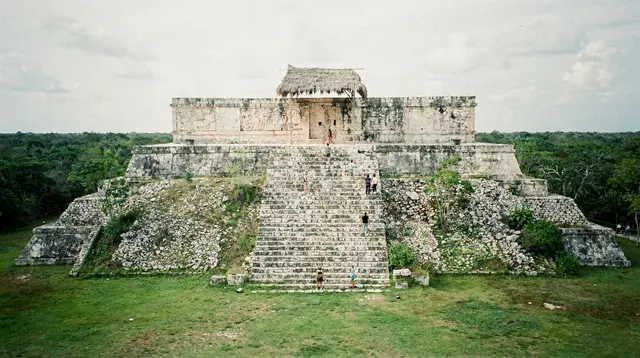
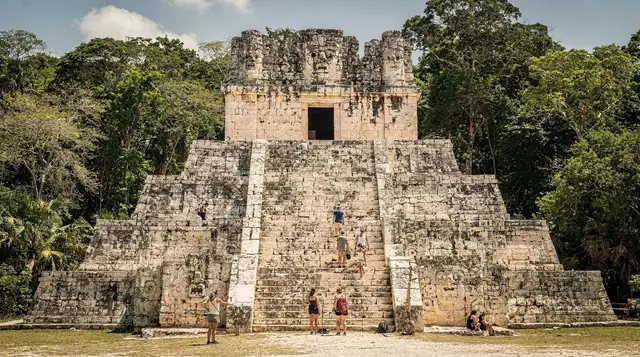
The centerpiece is El Torre / the Acropolis, a broad, roughly 30-meter structure with a steep stone staircase you’re allowed to ascend. At the time of writing, climbing is still permitted here — unlike Chichén Itzá’s El Castillo and Cobá’s Nohoch Mul, both now closed to climbers. From the top you get a sweeping view over an unbroken green carpet of Yucatán jungle, with no town or road in sight. That view, and the act of climbing, are exactly what most people come for.
Two honest caveats: the steps are steep and uneven, so anyone uneasy with heights or with knee trouble should think twice, especially on the way down. And rules can change without much notice — climbing access at Maya sites has been tightening across the region, so it’s wise to treat it as a bonus rather than a guarantee.
The frieze that makes it special
Halfway up the Acropolis, protected by a thatched roof, is one of the best-preserved pieces of Maya stucco art anywhere: an elaborate doorway carved as a monster’s open mouth, often called the “jaguar mouth,” framed by winged figures sometimes described as angels. It marked the tomb of the ruler Ukit Kan Lek Tok’. Because Ek Balam was buried and forgotten for centuries, this detailed stucco survived in remarkable condition — it’s the artistic highlight of the visit.
A site you can see in an hour
Ek Balam is small. Beyond the Acropolis there’s a tidy central plaza, two smaller pyramids, a ball court, and a distinctive oval palace, all enclosed by the remains of defensive walls. You can comfortably see everything in 1 to 2 hours without rushing. Entry is roughly 700 MXN for foreign visitors (INAH about 210 MXN plus a state fee; parking extra) — the higher price reflects the climbable structure; bring cash in pesos, as card payment isn’t reliable. A guide at the entrance adds useful context for a small group fee.
Cool off at Cenote X’Canché
Just a short walk or bike ride from the ruins lies Cenote X’Canché, a deep, jungle-ringed open cenote run as a community ecotourism project. After the climb it’s the natural reward — you can swim, and there are rope swings and zip-lines for an extra fee. Entry runs roughly 100–150 MXN, and a bike or pedicab from the ruins entrance covers the distance. Together, the ruins and the cenote make an easy, rewarding half-day. If you’d rather not organize it yourself, a Ek Balam, Valladolid market and cenote tour from Cancún bundles all three.
Getting there from Cancún and Valladolid
Ek Balam pairs naturally with Valladolid, only about 30 minutes away, and slots perfectly into an inland loop with Chichén Itzá. From Cancún it’s roughly two hours.
- Colectivo / taxi from Valladolid: colectivos run partway; a taxi round trip with wait time is a common, affordable choice.
- Rental car: the easiest way to combine Ek Balam, Chichén Itzá, and a cenote on one inland day.
- Tour: some operators pair Ek Balam with Chichén Itzá or Río Lagartos.
As with every inland site, go at the 8 am opening. Ek Balam is so small that even a few tour buses crowd the Acropolis, and the climb is far more pleasant in the morning cool.
A little history
Ek Balam was an important city and the seat of a powerful kingdom that peaked between roughly 700 and 1000 CE, ruled at its height by Ukit Kan Lek Tok’. Unlike Chichén Itzá, it was never a major tourist site until restoration work in the 1990s and 2000s uncovered the extraordinary stucco frieze and consolidated the Acropolis. Because the structures had been deliberately buried in antiquity, much of the original detail survived — which is why the carvings here feel sharper and more intact than at more famous, more weathered sites. The defensive walls ringing the core also set it apart: most Maya cities weren’t fortified, hinting that Ek Balam faced real rivals.
Combining it into an inland day
The smart way to fit Ek Balam in is to treat Valladolid as your hub and chain a couple of sites together. A classic morning runs: 8 am at Ek Balam and a dip in Cenote X’Canché, back to Valladolid for a Yucatecan lunch, then an afternoon cenote like Suytun or Oxman — or push on to Chichén Itzá if you’d rather do the big site after the small one. With a rental car this loop is easy and unhurried; by colectivo and taxi it’s still doable but takes more patience and waiting.
Because Ek Balam is so compact, it never needs a full day of its own. Pairing it with the cenote and the town is what turns a 90-minute ruin into a genuinely good half-day out — and keeps the long inland drive from Cancún feeling worthwhile. If you’re already based in town, a full-day Ek Balam and colonial Valladolid tour covers both without the driving.
What to bring
Pack the inland-Yucatán basics: water, a hat, sunscreen, and good shoes for the steep, uneven steps. Bring swimwear and a towel for the cenote, and small peso notes in cash for entry, parking, the guide, and the cenote, since card payment is unreliable out here. Go early not just for the crowds but for the light — the morning sun on the white Acropolis and the green canopy beyond makes the climb worth every step.
Should you add Ek Balam?
If you’re already staying in or passing through Valladolid, yes — it’s a short detour for a genuinely different experience: a climbable pyramid, a rare stucco masterpiece, jungle views, and a cenote, all without the crowds. If your time inland is limited to a single site, Chichén Itzá is the one to prioritize. But for travelers chasing the quiet, hands-on side of the Maya world, Ek Balam is one of the best small ruins in the Yucatán.
Ek Balam vs Chichén Itzá vs Cobá
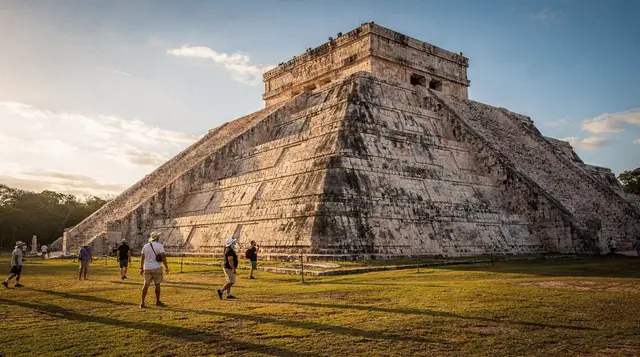
All three are Maya ruins reached from the same inland corridor, but they solve different priorities. Chichén Itzá is the famous, most crowded, and most impressive single monument, but you cannot climb anything. Cobá has taller structures and jungle trails you cover by bike or on foot, but its main pyramid, Nohoch Mul, closed to climbers some years ago. Ek Balam is the smallest of the three but the one where climbing is still allowed, plus its rare stucco frieze. See the Chichén Itzá vs Tulum vs Cobá guide for the fuller comparison, and the Cobá ruins guide if you’re weighing that site instead.
Planning the day: guides, tours and timing
If you’d rather not self-drive the inland loop, the Ek Balam ruins guide covers guided-tour options and how operators typically pair it with Chichén Itzá or Río Lagartos. For the definitive single-site day trip from Cancún or the coast, see the Chichén Itzá day trip guide, which shares the same early-start logic that makes Ek Balam worthwhile.
Walking the site: a suggested order
Most visitors head straight for the Acropolis, and that’s understandable, but the site rewards a slower approach. Start by walking in through the entrance gateway and the plaza, letting the scale of the place settle before you commit to the stairs. If you arrive at opening, you may well have the plaza almost to yourself, which makes it the best moment for photographs without strangers in the frame.
Take a look at the smaller pyramids and the ball court first, then the oval palace, and save the Acropolis for last or first depending on your energy. Climbing first means the steps are cooler and emptier; climbing last means you finish with the big view as a reward. Either works, but don’t leave the frieze for a rushed final minute. It sits partway up, under its protective roof, and it deserves a proper pause rather than a quick snapshot on your way to the summit.
Making the most of the Acropolis climb
Take the stairs at your own pace and use the landings to rest and look back over the plaza. Going up is the easy part; the descent is where people hesitate, so turn your body slightly sideways, keep a hand free, and don’t rush when others queue behind you. Leave bulky bags and anything dangling at the bottom, or carry only a small bag with water, so both hands stay free.
At the top, give yourself time. The jungle view is the reason the climb exists, and it’s a good place to understand why the Maya built here: the canopy runs flat to the horizon, and the structures below look surprisingly orderly against it. If you’re traveling with children, read Cancún with kids for general planning, and decide on the spot whether the steps suit them.
Understanding what you’re looking at
The history above is more vivid if you connect it to the wider Maya world. For background on the civilization behind these cities, the Maya culture in Yucatán guide is a useful companion read before you go. It makes the frieze, the walls and the layout of the plaza feel less like a pile of old stones and more like a place where people lived, ruled and worried about their neighbors.
A local guide can add a lot here, since much of what makes Ek Balam interesting, such as who is buried behind the doorway and why the walls were built, isn’t obvious from the stones alone. If you prefer to explore alone, read the Ek Balam ruins guide in advance so you know what to look for.
Where to base yourself
Ek Balam is a day outing, not a place to sleep, so the real question is where you stay nearby. Valladolid is the natural base: it’s an easy, walkable colonial town, and the Valladolid colonial guide explains what to do in the evenings once the ruins are done. If you’re short on time and want to keep your base on the coast, the Valladolid day trip guide shows how the same corridor works as a long day out from Cancún.
Staying in Valladolid also lets you hit the ruins at opening without a long early drive, which is the single best way to beat the tour vans. For more on choosing a base across the whole region, see where to stay in Cancún.
Getting around without a car
If you don’t want to drive, the ADO bus guide for Yucatán explains how to reach Valladolid by bus, and from there a taxi or colectivo covers the last stretch. For the bigger picture, the getting around the Riviera Maya guide compares options, and the Cancún car rental guide is worth reading if you’re leaning toward driving yourself. The Maya Train guide is also worth a look if you’re mapping out how inland sites connect.
Fitting Ek Balam into a longer trip
Ek Balam works well as one stop in a wider route. If you’re building a trip around ruins and cenotes, the Cancún cenotes and ruins 4-day itinerary shows how inland days can be sequenced, and the Yucatán 10-day road trip gives a slower, more complete loop through the peninsula. If you’re weighing which cenotes to pair with the ruins, see the best cenotes in the Riviera Maya and the family-friendly cenotes guide.
Visitors who want a fuller sense of the region can also read Cobá and Mérida as other inland stops, and the best day trips from Cancún, ranked helps you decide how much of your holiday to spend away from the beach.
Quick answers on climbing and combining Ek Balam
Can you still climb the pyramid at Ek Balam? Yes, at the time of writing — unlike Chichén Itzá’s El Castillo or Cobá’s Nohoch Mul, both now closed to climbers. Rules can change, so treat it as a bonus rather than a certainty and check current status before you build a trip around it.
Is Ek Balam worth it if I’m already visiting Chichén Itzá? Often yes, if you have a rental car or a tour that pairs the two — they’re different experiences (crowded and monumental versus small and climbable) and sit close enough together on the inland loop through Valladolid to combine in one long day.