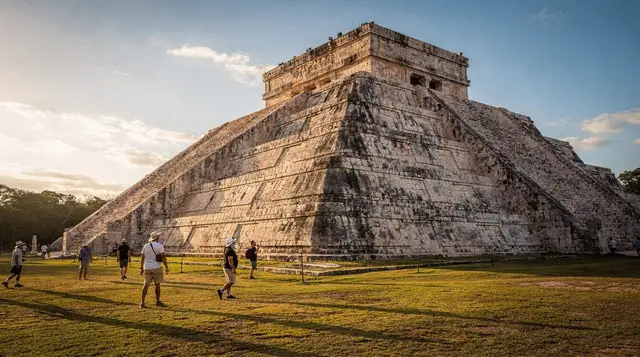
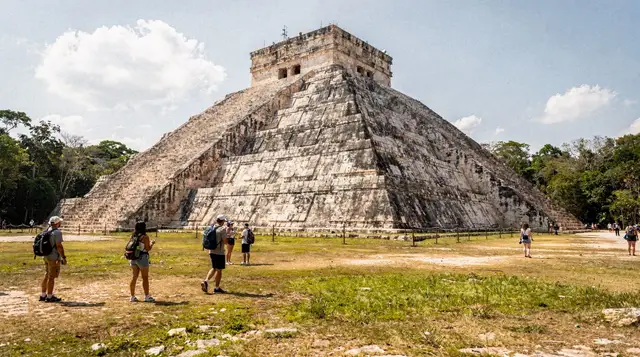
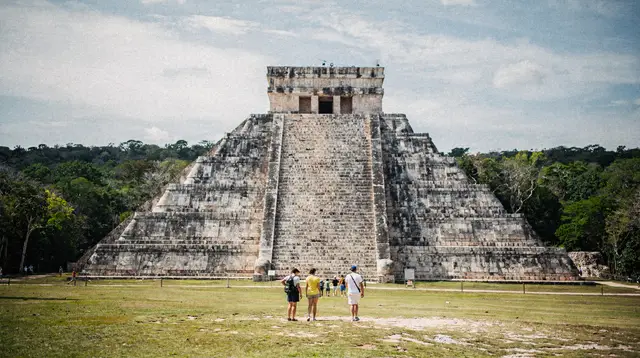
El Rey ruins: the Maya site in Cancún's Hotel Zone
Are the El Rey ruins in Cancún worth visiting?
El Rey is a small, modest Maya site in the Hotel Zone — worth a quick visit if you want a low-effort taste of ruins and you love iguanas, which swarm the grounds. Check the current entry fee on the INAH site; it takes 30–60 minutes. For genuine Maya scale, you still need to day-trip to Tulum, Cobá or Chichén Itzá.
El Rey is the Maya site hiding in plain sight in Cancún’s Hotel Zone — a small archaeological zone wedged between the boulevard and the lagoon, overrun with iguanas. It is cheap, quick and convenient. It is also genuinely minor, so let’s set expectations honestly.
At a glance
| Where | Boulevard Kukulcán, Km 17-18, near Playa Delfines |
| Cost | Check the current fee on the INAH site |
| Time needed | Around 30-60 minutes |
| Getting there | R-1 or R-2 bus along the boulevard (~12 MXN flat fare) |
| Best time | Early morning, around opening (8-9am) |
What El Rey actually is
El Rey (Zona Arqueológica El Rey) is a modest Maya settlement on Boulevard Kukulcán around Km 17–18, near Playa Delfines at the southern end of the Hotel Zone. It has the remains of low platforms, a small ceremonial structure and the foundations of a former marketplace, laid out along a central path. It was a fishing and trading community, not a monumental city.
Be clear-eyed: there are no soaring pyramids here. The structures are low and ruined, and the whole thing is small. What it offers is a real (if minor) Maya site you can reach on the city bus in minutes, surrounded by dozens of iguanas sunning themselves on the stones — which, for many visitors, is half the fun.
A little history
The name “El Rey” (“the king”) comes from a sculpted head and figure found here, thought to depict a ruler. The settlement belonged to the same coastal Maya trading network as Tulum and El Meco (another small site on the mainland north of Cancún), and it was occupied late in the Maya timeline, flourishing roughly between the 13th and 16th centuries before contact with the Spanish.
It would have been a stop on the maritime trade routes that ran salt, honey, cotton and obsidian along this coast. The two parallel rows of structures along a central avenue mark it as a planned little urban core rather than a random scatter of buildings — which is genuinely interesting once you know what you are looking at, even if the stones themselves are humble.
This context is the difference between “some low walls and lizards” and “a real Maya trading town swallowed by a resort strip.” A few minutes reading the on-site panels (or this page) before you go transforms the visit.
Tickets and costs
Check the current entry fee on the INAH site; bring cash in MXN for the gate. There is no need for a guide for a site this small, though one may be available. Budget 30–60 minutes total. Compared with a day-trip to a major site, it is cheap and close, but you are paying for convenience, not grandeur.
Getting there
This is the easy part. El Rey is right on the Hotel Zone’s single boulevard:
- Take the R-1 or R-2 bus along Boulevard Kukulcán (flat fare ~12 MXN) and get off near Km 17–18; the site is roadside.
- It is walkable from the Playa Delfines beach and the Cancún sign, so you can combine the two in one outing.
- A taxi works but costs far more than the bus for the same short hop.
When to go
- Best: early morning (it generally opens around 8–9am) — cooler, and the iguanas are out basking. Midday is hot with little shade.
- Dry season (December–April) is most comfortable, but since the visit is short, any clear day works.
- The site is exposed — bring water, a hat and sunscreen even for a half-hour.
Because the visit is so short, El Rey slots neatly into a wider Hotel Zone morning: ruins at opening, then the beach at Playa Delfines a couple of hundred metres away, then back on the R-1 for lunch. It is one of the few “culture” stops in the Hotel Zone that does not involve a long drive, which is its real selling point. Photographers should note the low morning light rakes nicely across the stone platforms and the lagoon behind, and that is also when the iguanas are most photogenic on the warm rock.
The iguana factor
There is no point pretending otherwise: for a lot of visitors El Rey is as much an iguana encounter as a ruin. Dozens of large iguanas live among the stones, basking on the platforms and crossing the paths. They are harmless if left alone — do not feed or touch them. Kids tend to love it, and it makes the modest archaeology far more entertaining. Move slowly, keep a respectful distance, and they will mostly ignore you; the bigger males can be a metre or more long and will hold their ground rather than flee, so do not corner one for a photo. Early morning, when they emerge to warm up on the sun-facing stones, is the best time to see them in numbers.
Walking the site, step by step
The visit follows a simple loop, so there is no need to plan a route. Enter, follow the central path, and take the structures in the order they appear. The low platforms come first, and the small ceremonial building sits further along. The foundations of the old marketplace are the easiest part to miss, because they look like little more than outlines on the ground. Slow down there and picture the stalls, the canoes pulled up on the lagoon side and the traders passing through. That is the moment the place stops being “some stones” and becomes a working coastal town.
Wear shoes with a decent grip. The stones are uneven and the paths can be dusty, and you will stop often to watch an iguana or take a photo. Keep your bag zipped and your hands free. A short visit is easier when you are not juggling a towel, a drink and a camera. If you are coming straight from the beach, leave the wet gear in your bag or at the hotel and carry only what you need.
Who will enjoy it most
- Families with children. The iguanas turn the site into a safari on a very small scale, and the short loop suits young legs. Our Cancún with kids guide has more ideas for keeping a family day easy.
- Curious travelers on a tight schedule. If you only have a free morning in the Hotel Zone, this is the one ruin you can fit in without a day of transport.
- Photographers. Low platforms, lizards and lagoon light make for good pictures, especially early in the day.
- Budget-minded visitors. It is one of the cheaper cultural stops in the area. The Cancún budget guide shows where else you can save without missing out.
It will frustrate anyone who arrives expecting climbable pyramids or a full day of exploring. If that is you, skip ahead to the inland sites below.
Fitting El Rey into your itinerary
Because it is so short, El Rey is an easy filler between bigger plans. It works on the morning after a late night, on the day you arrive, or on the day before you fly home when you want something light. Our 2-day Cancún itinerary and 3-day Cancún itinerary are tight, so a short ruins stop fits best on a slower day. If you have longer, the 5-day Cancún itinerary leaves room for it alongside a beach morning. Anyone planning a proper archaeology trip should look at the Cancún cenotes and ruins itinerary, which builds the real Maya sites into a schedule.
If you are still deciding how many days to spend in town, read how many days in Cancún. For general planning, Cancún travel tips covers the basics that apply to every outing, including sun, water and getting around.
Context: Maya sites across the region
El Rey is one of several places where you can see how the Maya lived along this coast. To understand what you are looking at, Maya culture in Yucatán gives the background on the people, their trade and their beliefs. The nearby coast has more on offer: Tulum has the famous clifftop site, Cobá has the tall pyramid in the forest, and Ek Balam and Chichén Itzá are the bigger inland draws. Each has its own destination page if you want to compare bases and routes. For a day that adds a swim, a Tulum ruins and cenotes combo tour pairs the clifftop site with a cenote stop.
For getting to those sites, getting around the Riviera Maya explains the options, and the ADO bus guide is useful if you prefer not to drive. A rental car gives the most freedom if you want to string several ruins together. If you would rather skip the logistics, a guided Tulum ruins tour from Cancún covers the transport for you.
Weather, sun and comfort
The site has little cover, so how comfortable you are depends on timing and preparation. A hat, water and sunscreen matter more here than the size of the site suggests. If the weather turns, you can simply leave, since there is no long walk back to the road. For a sense of the seasons and what to expect from them, see the best time to visit Cancún and the notes on hurricane season. On days when seaweed spoils the beach, a ruins stop is a sensible plan B, and the sargassum guide explains what to expect.
El Meco — the other Cancún ruin
If El Rey leaves you wanting slightly more, there is a second small site near Cancún: El Meco, on the mainland on the road toward Puerto Juárez and the Isla Mujeres ferry. It is also modest but has a taller structure (a small pyramid you can look up at), is even quieter than El Rey, and charges a similar small entry fee. Neither is a substitute for a real Yucatán ruin, but together they make a cheap, easy half-day of low-key archaeology without leaving the Cancún area — handy on a sargassum day or a travel day when you cannot commit to a full inland trip.
The honest verdict — and the real alternative
El Rey is worth a quick stop if you are already in the southern Hotel Zone (say, visiting Playa Delfines and the Cancún sign), want a cheap, easy taste of Maya ruins, and enjoy the iguanas. As a 30–60 minute add-on, it delivers.
It is not a substitute for the real thing. If you want the Maya experience that justifies a trip to the Yucatán, you still need to day-trip out:
- Tulum — Maya city on a Caribbean cliff (scenic, compact).
- Cobá — tall jungle pyramid, big and atmospheric.
- Ek Balam — still-climbable acropolis with superb stucco carvings.
- Chichén Itzá — the marquee site, ~2.5 hours inland.
Treat El Rey as a convenient bonus, not the headline. If you want a fuller comparison of how these sites stack up against each other, see Chichén Itzá vs Tulum vs Cobá.
Other quick Hotel Zone stops to pair with it
El Rey works well stitched into a low-key Hotel Zone morning rather than visited alone. Playa Delfines is a two-minute walk away and free to enter (all Mexican beaches are public), so ruins-then-beach is the natural combo. If you are staying downtown rather than in the Hotel Zone, the R-1/R-2 bus also connects easily to downtown Cancún for lunch afterward, and travelers deciding between a Hotel Zone base and a downtown one can weigh the trade-offs in is the Hotel Zone worth it.
Frequently asked questions about El Rey ruins
Can I visit El Rey without a car? Yes — it is one of the easiest ruins in the region to reach without a car. The R-1 or R-2 bus runs the length of Boulevard Kukulcán for a flat fare of around 12 MXN, dropping you right at the site.
Is El Rey worth it if I’ve already seen Tulum or Chichén Itzá? Only as a quick, cheap add-on. It has no comparable scale, but the iguanas and the convenience make a nice half-hour if you are already at Playa Delfines and have time to spare.
Practical checklist
- Entry fee: check the INAH site, cash MXN; allow 30–60 minutes.
- Reach it on the R-1/R-2 bus (~12 MXN) at Km 17–18.
- Combine with Playa Delfines and the Cancún sign next door.
- Bring water, hat, sunscreen — little shade.
- Don’t feed the iguanas.
- Don’t expect pyramids — save those for a Tulum, Cobá or Chichén Itzá day.
In short: El Rey is a pleasant, cheap, iguana-filled half-hour that scratches the “I saw a Maya ruin” itch without leaving the Hotel Zone — best enjoyed as a bonus stop on a Playa Delfines morning rather than a destination in its own right. Keep the real archaeology ambitions for a day-trip inland. For the Hotel Zone context see Cancún Hotel Zone, and for the proper Maya day-trips, Tulum ruins guide and Chichén Itzá day trip.
Popular Cancún tours on GetYourGuide
Verified deep-linked GetYourGuide tours. Book through these links and we earn a small commission at no cost to you.
These are our own photographs of the area, not the operator's pictures of this tour — open the tour page to see those.