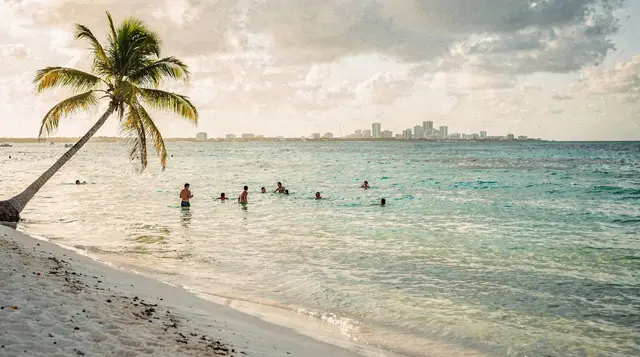
The Hotel Zone (Zona Hotelera) is the postcard you booked: a 22 km sandbar shaped like a number seven, lined with resorts, beach clubs, and malls, with the Caribbean on one side and the Nichupté Lagoon on the other. It is comfortable, walkable in stretches, and genuinely beautiful in the right light. It is also the most expensive, most touristed slice of the whole region — so it helps to know exactly what you’re getting.
| Where | 22 km barrier island, Boulevard Kukulcán, km 0–20+ |
| Cost | Non-resort hotels from ~1,400 MXN; mid-range resorts ~2,500–4,500 MXN/night |
| Time needed | 2–3 days, more for pure beach time |
| Getting there | ~20 min from CUN airport by ADO bus (~110 MXN) or taxi (~700–900 MXN) |
| Best time | December–April for calm sea and least sargassum |
What the Hotel Zone actually is
Think of it as a single long boulevard, Boulevard Kukulcán, running from downtown out to the southern tip and back. Addresses are given in kilometres (“km 9”, “km 20”), and the bus drivers and taxis all speak in those numbers. Most resorts, the big nightclubs, the convention center, and the Maya ruins of El Rey all sit along this strip. You can spend a whole week here and never see the real city — which is fine for some, and a missed opportunity for others.
The lagoon side has marinas, jungle tours, and sunset views; the Caribbean side has the beaches. The narrowest part of the sandbar is only a few hundred metres across, so the sea is rarely far.
The catch nobody mentions: which way your beach faces
Here is the single most useful thing to know before booking. The Hotel Zone bends, so beaches face different directions, and that changes everything.
- North-facing beaches (roughly km 1–9, near Playa Las Perlas, Langosta, Tortugas, and Caracol) face Isla Mujeres and the bay. The water is calm, shallow, and turquoise, with far less sargassum seaweed. Great for families and weak swimmers.
- East-facing beaches (roughly km 9–20, the long outer stretch including Playa Delfines and Playa Marlin) face the open Caribbean. Bigger waves, stronger currents, more dramatic — and far more likely to collect sargassum from spring through late summer.
If calm, clear water matters most to you, book a resort on the north-facing stretch. If you want that open-ocean horizon and don’t mind a rougher swim, the east side delivers. Either way, every beach in Mexico is public by law, so you can walk onto any of them via the public access points even if you’re not a guest.
Where to stay, by budget
You don’t have to go all-inclusive, despite what the booking sites push. Real ranges, in low-to-shoulder season:
- Budget / hostel-style: ~400–800 MXN (~22–45 USD) a night exists, but mostly downtown, not on the strip. In the Hotel Zone itself, simple non-resort hotels start around 1,400–2,200 MXN (~80–125 USD).
- Mid-range resort: roughly 2,500–4,500 MXN (~140–250 USD) a night, often half-board or all-inclusive.
- Upper-end all-inclusive: 5,000–12,000+ MXN (~280–680+ USD) per night, two adults.
A practical alternative many first-timers overlook: stay in Downtown Cancún where rooms are a fraction of the price and food is cheaper and better, then bus to the beach in 20–30 minutes for a few pesos. You trade beachfront convenience for a much lower bill and a taste of the real city.
Getting around without overpaying
The R-1 and R-2 buses run the length of the boulevard and into downtown constantly, day and night. A ride is a flat ~12 MXN (under 1 USD) paid in cash to the driver — by far the cheapest way to move. Keep small bills.
Taxis do not use meters here. Agree the price before you get in, and expect tourist pricing: a short hop within the zone is often quoted at 150–250 MXN, a run downtown 250–400 MXN. Ride-hail apps operate in Cancún but pickups in the Hotel Zone can be slow and are sometimes discouraged near resorts. When in doubt, the bus wins. If you land late or are travelling with luggage and kids, a private airport transfer to the Hotel Zone fixes the price in advance.
Beaches worth your time
- Playa Delfines (km 18): the famous one, with the colorful CANCÚN sign and a wide-open view. No resort sits directly on it, so it feels public and unhurried — but it’s east-facing, so expect waves and seasonal seaweed.
- Playa Las Perlas (km 2): shallow, calm, family-friendly, north end.
- Playa Tortugas (km 6): calm water, a ferry dock for Isla Mujeres, food stalls, and a livelier crowd.
- Playa Caracol (km 8): the calmest swimming near the corner of the strip, popular for paddleboarding.
When to come, and the sargassum reality
December to April is the sweet spot: dry, sunny, calm sea, and minimal seaweed. Sargassum — brown floating seaweed that washes up and smells as it rots — is the honest downside of the Caribbean coast, typically worst from roughly May through August, though it varies year to year and resorts on the east side spend a fortune raking it daily. The north-facing beaches and the islands (Isla Mujeres, Holbox) are far less affected, which is one more reason to plan a day or two off the strip.
Hurricane season runs June to November, peaking September–October. Direct hits are rare, but September is the gamble month for rain and the occasional storm.
Is the Hotel Zone worth it?
For a first trip with limited time, yes — it’s easy, safe, and the beaches are real. But don’t let it become your whole holiday. The strip is engineered for tourists, the food is pricier and blander than downtown, and the most memorable parts of this region (cenotes, the Maya ruins, Isla Mujeres, the quieter towns down the coast) are all day trips away. Use the Hotel Zone as a comfortable base, then get out of it.
Nightlife and the convention/marina side
The Hotel Zone is also the region’s nightlife hub, centred on the Party Center strip (km 9) with clubs like Coco Bongo running big-production shows rather than plain dance floors — expect a cover charge and, for the bigger acts, a real show worth budgeting for. The lagoon side has a string of marinas offering sunset catamaran cruises, jungle-tour speedboats through the mangroves, and fishing charters; these are a good way to see the Nichupté Lagoon that most beach-focused visitors never notice. The nightlife guide and the Coco Bongo guide go deeper on what to expect and how to avoid overpaying for tickets bought last-minute at the door. If you’d rather not plan the night yourself, a three-club night tour with open bar bundles entry and drinks.
Day trips that make the Hotel Zone work as a base
Because the strip itself is compact, most visitors treat it as a jumping-off point. The ferry to Isla Mujeres leaves from Puerto Juárez and from a dock inside the Hotel Zone (Playa Tortugas/El Embarcadero), making a half-day beach escape easy without a car; couples who prefer a boat day can book an adults-only Isla Mujeres catamaran with snorkeling. Inland, Chichén Itzá and the cenotes around Valladolid are a full-day trip (roughly 2.5 hours each way), best started early. South along the coast, Playa del Carmen and Tulum are reachable by ADO bus or rental car in under two hours. The how many days in Cancún guide helps balance beach time in the Hotel Zone against these trips.
Choosing between the Hotel Zone, downtown and the coast
The real question for most first-timers is not whether the Hotel Zone is nice, but whether it is the right base for the trip they have in mind. If your plan is mostly sand, a pool and a short transfer from the airport, the strip makes sense, and the airport to Hotel Zone guide walks through the options so you arrive without a nasty surprise. If you want to eat well, wander and spend less, the where to stay in Cancún guide lays out the trade-offs between the strip, downtown and the towns further south.
It also helps to ask yourself how much of the week you want to spend in transit. Staying on the strip keeps the beach a few steps away, but every excursion starts with a trip along the same boulevard. Staying elsewhere flips that equation. Neither is wrong; they simply suit different travellers. A couple chasing a quiet week will often be happiest in a north-facing resort, while a group that wants to see ruins and cenotes may prefer to keep the hotel simple and spend the budget on experiences. The Cancún vs Playa del Carmen vs Tulum comparison is a good read before you commit.
All-inclusive or not
Booking sites push all-inclusive packages hard, and for some people they are genuinely the right call: no bill at the end, food and drinks always within reach, and an easy rhythm for families with children. The downside is that you eat where you sleep, and the best food in the region is rarely inside a resort buffet. If you like to explore, a room-only or breakfast-only rate leaves you free to try the taquerías and seafood places that make Cancún worth eating in. The all-inclusive vs not guide works through who benefits from each, and the Cancún food guide shows what you would be missing if you never leave the resort.
Travelling with children
The north-facing beaches are the natural choice for families, since the shallow, gentle water is easier to supervise. Many resorts here are designed around children, with pools, shaded areas and activities that keep a day easy. Pace matters more than ambition: short outings, plenty of shade and a flexible plan usually beat a packed schedule. For ideas on what suits different ages, see the Cancún with kids guide and the family 5-day itinerary.
Planning your days
Two or three days is enough to enjoy the strip, but how you split them makes a difference. A relaxed first morning on the beach lets you recover from the journey. A day on the lagoon, whether at sunset or on a boat tour, shows you a side of the Hotel Zone that most guests never see. The rest is best spent off the sandbar. The 2-day itinerary and the 3-day itinerary show how to mix beach time with excursions, and the Cancún budget guide helps you decide where extra money is worth spending.
Before you go, check the season too. The best time to visit Cancún guide explains how the months differ, and the sargassum guide is worth a look if seaweed would spoil your trip. If you want to know how the strip fits into the wider region, the Cancún destination page puts the Hotel Zone, downtown and the islands side by side. And if the practical details are worrying you, the Cancún travel tips cover the small things that make a first visit smoother.
Small habits that make the stay easier
A few simple habits go a long way here. Carry small bills for buses and street food, since change is not always available. Bring a reusable bottle and sun protection, because the sun is strong even on cloudy days. Be polite and clear when agreeing a taxi fare, and keep your plans flexible in case the weather or the sea changes your mind about which beach to visit. Finally, remember that the public access points exist for a reason: you do not need to be a guest of a resort to enjoy the sand, and the public beach access guide shows how to use them. None of this takes much effort, and together these habits tend to separate a stressful first trip from a relaxed one.
Frequently asked questions about Cancún Hotel Zone
Which part of the Hotel Zone has the calmest water? The north-facing stretch, roughly km 1-9 (Playa Las Perlas, Langosta, Tortugas, Caracol), facing the bay toward Isla Mujeres — shallow, calm, and far less prone to sargassum than the east-facing outer strip.
Do you need a car in the Hotel Zone? No — the R-1 and R-2 buses run the length of Boulevard Kukulcán constantly for a flat, tiny fare, and taxis cover anything the bus doesn’t. A car mainly helps if you’re planning several independent day trips inland.