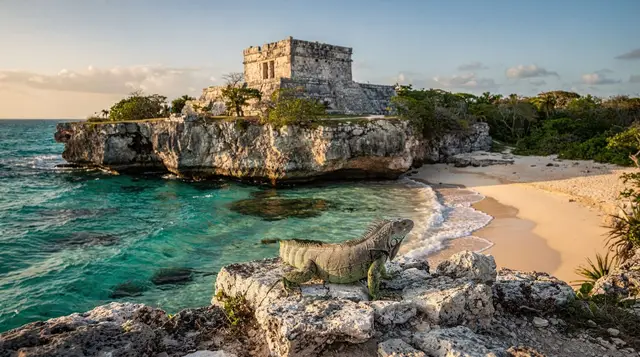
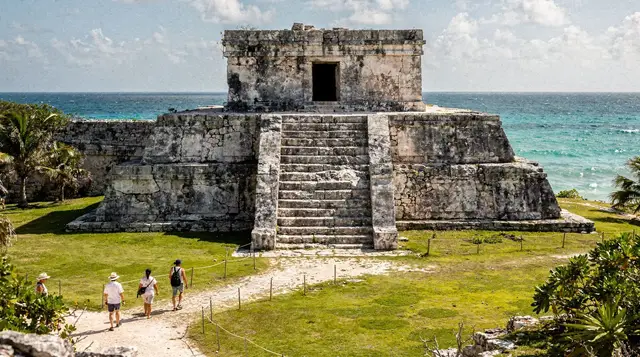
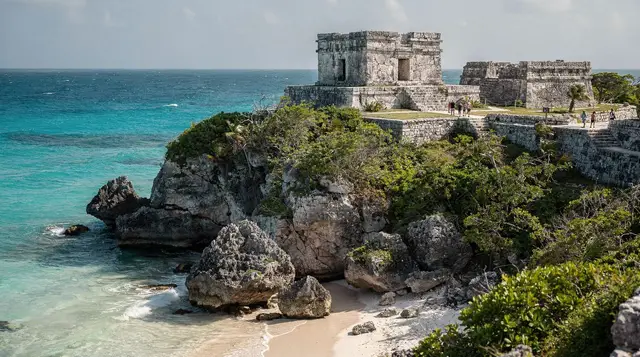
The Tulum Ruins are the reason most people make the trip south: a small, walled Maya city perched on a low limestone cliff directly above the turquoise Caribbean. It is the only major Maya site built on the coast, and that setting — grey stone temples against impossibly blue water — is what makes it unforgettable. The archaeology itself is modest compared with Chichén Itzá or Cobá, but no other site has this view.
At a glance
| Where | Coastal cliff, about 4 km north of Tulum pueblo |
| Cost | Entry now over 200 MXN since January 2026 (see inah.gob.mx) |
| Time needed | 1.5–2 hours on site |
| Getting there | ~2 hrs south of Cancún; bike, taxi, or shuttle from the pueblo |
| Best time | 8am opening, dry season (November–April) |
What the site is
Tulum was a walled Maya port city, at its height between roughly the 13th and 15th centuries, that traded along the coast and inland. The defensive wall on three sides (the sea guards the fourth) gives the site its old Maya name, Zama, often translated as “dawn,” because it faces the sunrise. The buildings are smaller and more weathered than the inland sites; the draw is the ensemble and the location, not towering pyramids.
The standout is El Castillo, the cliff-edge temple that anchors every photo. Around it sit the Temple of the Frescoes (with traces of original murals) and the Temple of the Descending God. You walk a marked loop along the cliff and through the grounds; the whole site is compact and takes about 1.5 to 2 hours.
The catch: heat, crowds and roped-off ruins
Be ready for two things. First, it is hot and almost completely shadeless — the site sits on open coastal scrub with no tree cover, and midday here is punishing. Second, it gets crowded fast: tour buses from Cancún and Playa del Carmen arrive from mid-morning, and the narrow paths bottleneck. The single best move is to be at the gate for the 8am opening, before both the heat and the buses.
You also cannot climb the structures — they are roped off to protect them — so this is a walk-and-look, not a clamber-up site. Iguanas are everywhere and harmless.
The beach below
Tucked below the cliff is a small cove with a sandy beach, reachable by a wooden staircase from inside the site (it can close when the sea is rough or for conservation). It is one of the most photogenic spots in the Riviera Maya — ruins above, swimmers below. Bring a swimsuit and a quick-dry towel if you want a dip, but note it is small and fills up; for a proper beach day, the Tulum beach zone strip to the south is far better.
Practical visit: tickets, access and what to bring
INAH raised its rates in January 2026, so entry is now over 200 MXN at the INAH booth, depending on extra access and protected-area fees (check inah.gob.mx for the current price); pay in pesos. The site is open 8am–5pm, with last entry at 3:30pm. From the highway, a long access road leads to the entrance, with a paid parking area and a small commercial strip of shops and a tourist tram (optional, small fee) for the final stretch. Bring water, a hat, reef-safe sunscreen, and proper shoes — tap water is not drinkable in Mexico and there is no shade.
From Tulum pueblo (about 4 km away) you can cycle, take a quick taxi, or grab a colectivo on the highway and walk in. Many day-trippers arrive on organised shuttles from Cancún or Playa del Carmen; those typically combine the ruins with a cenote — the Tulum day trip from Cancún guide covers the logistics if you’re not staying overnight, and the Cancún to Tulum transport guide breaks down bus, shuttle, and drive options in detail.
What to combine it with
Almost nobody visits the ruins in isolation. The most common — and most satisfying — pairing is an early ruins visit followed by a swim: Gran Cenote is minutes away and the natural cool-down after a shadeless, sweaty morning, and the cenotes near Tulum guide lists the full shortlist by crowd level and swim style. To skip the planning, a Tulum tour with Dos Ojos, Gran Cenote and the ruins bundles all three. If you have more than a half day, pair the ruins with a night or two in the Tulum pueblo for cheap food and easy onward transport, or extend inland to Valladolid and Chichén Itzá for the region’s biggest archaeological sites.
A note on timing across the year: the dry season, November to April, brings the clearest light and least humidity, which matters at a fully exposed site. The summer and autumn months are hotter, more humid, and fall in hurricane season (peaking September–October), when occasional storms can briefly close the site or the beach stairway. Whenever you go, the 8am opening is the single most useful piece of advice — the difference between a calm, photogenic morning and a hot, shoulder-to-shoulder crush by 11am is dramatic.
Guided or self-guided?
The site is small and easy to walk on your own, and a self-guided visit with a good map or app is perfectly satisfying for most people — there are some interpretive signs, though not many. If you want the history brought to life, freelance guides wait near the entrance and charge roughly 600–1,000 MXN (about 34–56 USD) for a small group; agree the price and language up front. Many organised tours from Cancún or Playa del Carmen bundle a guide, transport, and a cenote stop, which can be the simplest option if you do not want to arrange transport yourself, but you sacrifice the early-opening advantage because tour buses tend to arrive later in the morning. If that trade-off suits you, a guided Tulum Ruins tour from the Riviera Maya keeps things simple.
Tulum Ruins versus the inland sites
It helps to know what Tulum is and is not. For sheer scale and architecture, Chichén Itzá (about 2.5 hours inland, never to be confused with coastal Tulum) and Cobá (about 45 minutes away, with a tall jungle pyramid) are more impressive ruins. Tulum’s trump card is its setting on the sea, which neither inland site can match. A common, satisfying plan is to see Tulum for the views early in your trip and then do one bigger inland site like Chichén Itzá or Cobá on a separate day for the archaeology.
How to visit well
Tulum Ruins reward an early start more than almost any site in the region. Arrive at opening, do the cliff loop first for clear photos and cooler air, dip into the cove if it is open, and be walking out as the crowds pour in. Pair it with a swim at a nearby cenote — Gran Cenote or Dos Ojos are minutes away and the perfect cool-down after a shadeless morning. For a deeper breakdown of tickets, timing tricks, and guided versus self-guided options, see the dedicated Tulum ruins guide. For where to swim and stay afterwards, the Tulum beach zone is just down the coast.
Walking the site: a suggested order
Once through the entrance, resist the urge to head straight for the most famous view. The paths here form a loose loop, and the best approach is to follow it calmly rather than chase one photo. Start by letting the layout sink in: the wall, the gateways through it, and the open grounds beyond. This is what separates a defended port from a ceremonial centre, and it helps the rest of the visit make sense.
From there, head toward the cliff edge and work along it. El Castillo is the obvious focal point, but the smaller buildings near it reward a slower look. The Temple of the Frescoes and the Temple of the Descending God are easy to walk past while people queue for photos, yet they are where the site’s details live: carved figures, traces of paint, and the sense that this was a working town rather than a monument. Take your time on the cliff path itself, where the sea breeze is the only relief from the sun.
Leave the beach cove for the end of the loop if the staircase is open. That way the swim is a reward, not an interruption, and you are already heading back toward the exit when you dry off. If the stairs are closed, the view down onto the cove from above is still one of the best on the whole coast.
Photography without the crowd
Photographers love Tulum for good reason, and the site is easier to shoot well than most. The stone is pale, the sea is vivid, and the cliff gives you a clean horizon. Early in the day the light is softer and the paths are quieter, so you can frame El Castillo without a line of strangers in the shot. Later, the sun is harsher, the sea washes out, and every angle has people in it.
A few habits help. Shoot the wide, scenic views first, while the grounds are still empty, and save the details (carvings, lizards, textures of the weathered stone) for when the crowds arrive, since those do not depend on an empty frame. Keep your gear light: there is no shade to set up in, and a heavy bag becomes a burden quickly. Be patient at the popular viewpoints, step aside once you have your shot, and remember that the ropes are there for a reason. Staying behind them is part of visiting respectfully.
Visiting with kids, older travellers or limited mobility
The site is compact and mostly flat, which makes it more approachable than many Maya ruins. Children usually enjoy the iguanas and the cove, and the lack of climbing means fewer worries about little ones near steep steps. For a wider look at what works for families across the region, see the Cancún with kids guide and the family-friendly cenotes guide, which pairs well with a ruins morning.
The real challenge is the sun, not the distance. Plan around the early opening, carry plenty of water, and build in rest stops wherever you find a bit of breeze. Older travellers and anyone sensitive to heat should treat the visit as a short, slow morning rather than a full day. The paths are uneven in places, so sturdy, closed shoes are a better choice than flip-flops. The optional tram on the access road can save some walking before you even reach the gate.
Where the ruins fit in a longer trip
Tulum Ruins work best as one chapter of a longer story rather than a standalone outing. If you are still deciding where to base yourself, the Cancún vs Playa del Carmen vs Tulum comparison lays out the trade-offs, and the Cancún vs Riviera Maya guide helps you choose between a resort base and a more spread-out trip down the coast.
For a ready-made plan, the Tulum 3-day itinerary builds the ruins into a relaxed stay, while the Cancún cenotes and ruins 4-day itinerary and the Riviera Maya 7-day itinerary fold them into wider routes. If you want to compare the big three archaeological sites before committing your time, the Chichén Itzá vs Tulum vs Cobá guide is the place to start, and the Cobá ruins guide goes deeper on the jungle option. If you want both in one day, a Cobá, Tulum, cenote and Playa del Carmen combo tour covers them together.
Anyone interested in the people behind these places will get more from the visit after reading the Maya culture guide. Even a short read beforehand turns a pile of weathered stone into something with a story, and it makes the signs and any guide’s commentary easier to follow.
Before and after: food, beaches and getting around
A morning at the ruins builds an appetite. The Tulum restaurants guide has options for a proper meal once you are back in town, and the Tulum pueblo is usually the easier, more relaxed choice for eating than the busier spots near the beach. If the beach is what you want next, the Tulum beaches guide and the Tulum beach clubs guide cover the stretch of coast south of the site, from quiet sand to livelier spots.
Getting around the area is simple once you know your options. The getting around the Riviera Maya guide explains how buses, taxis and shared vans work, and the Cancún car rental guide is worth a look if you want the freedom to leave when you like and add a cenote stop on the way back. Travellers coming by rail can check the Maya Train guide for how it fits into the picture.
For a bigger-picture view of the area, the Tulum destination page ties together the ruins, the pueblo and the beach strip. If you want one more swim before heading home, the best cenotes in the Riviera Maya shortlist and the Dos Ojos cenote guide have plenty of ideas, and the Cancún travel tips page covers general advice that applies on every day of the trip.
Frequently asked questions about Tulum Ruins
Do I need to book Tulum Ruins tickets in advance? No — the ruins don’t require advance tickets; you buy at the INAH booth on arrival. Only combined shuttle-and-cenote tours are worth booking ahead in peak season.
How long does it take to see the Tulum Ruins? Most visitors need 1.5 to 2 hours for the cliff loop, the main temples, and a stop at the beach cove if it’s open.